Dragons
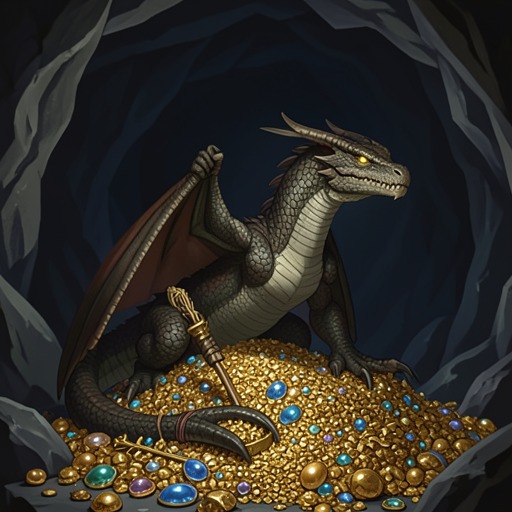
Vainqueur the DragonDragons are the dominant mythic and political species in the narrative, combining overwhelming physical power with an unexpectedly flexible capacity for social, economic, and institutional change. They are presented first through Vainqueur the Dragon, a sixty-foot legendary beast whose radiant scales, black wings, horned crown, and enormous hoard make him an almost textbook embodiment of the old dragon archetype. Yet the story steadily expands that image: dragons can acquire class levels, pursue professions, command territories, raise families, form rivalries, and turn the logic of treasure-hoarding into a system of adventuring, law, and government.
Nature and Traditional Life
Vainqueur’s opening scene establishes the traditional dragon way of life through sleep, appetite, violence, and accumulated treasure. He awakens from a long rest in a cave deep within the southern mountains of the Albain Mountains, stretching across a hoard of rubies, diamonds, and gold coins. The wealth has been taken from beastkins, mermaids, an elven princess’s retinue, and armored manlings foolish enough to challenge him. Even after this history of conquest, Vainqueur considers the hoard small and resolves to double it before returning to hibernation. His immediate concern is equally conventional: he wants to eat cattle, and he considers raiding the Dwarves because their underground vaults supposedly contain immense quantities of gems.
The dragon’s relationship with treasure is not merely financial. The hoard is a physical record of victory and a source of identity, comfort, and status. Vainqueur surveys it with admiration, regards the silver rapier being cleaned by a terrified Goblin minion as one of its finest pieces, and treats the entire cave as the visible proof of his superiority. Later, when he lacks a hoard to display, the absence wounds his dignity even though he refuses to show grief. This attachment gives dragon culture a material center: wealth is food, history, prestige, and emotional security at once.
The narrative also suggests that dragons possess extraordinary longevity. Vainqueur imagines spending another half-century in his cave, and he remembers flying over the region two centuries earlier. That memory becomes a measure of environmental and historical change when he notices that the countryside, once much greener, has deteriorated into badlands and the beginning of a red desert. The dragon does not initially respond as an ecological witness or reformer; he simply notes the transformation and returns his attention to the cheerfulness produced by his hoard. His ancient perspective nevertheless places mortal settlement, war, and environmental catastrophe within a much longer continuum.
Class System and Adaptability
The discovery that dragons can participate in the Class System overturns the assumptions of the human characters. Charlene realizes with alarm that dragons can gain class levels, while Victor reports that Vainqueur has already advanced in the Noble class. The revelation changes dragons from fixed monsters into developing agents whose powers can increase through recognized systems of progression. It also creates a direct challenge to the old division between civilized adventurers and creatures treated as targets for extermination.
The available classes are divided into Fighters, Spellcasters, Rogues, Crafters, and rare Monster classes. Dragons are not restricted to a single identity within that structure. When Croissant asks whether dragons can be wizards, Vainqueur answers that dragons can be anything. His claim is comic in its arrogance, but it is also substantially true: dragons can enter classes, gain abilities, and pursue routes that their traditional biology and reputation would not predict. Vainqueur considers the Wizard class despite Victor’s warning that the choice is strategically poor and would require at least fifty years of study to approach Furibon’s level. The exchange shows both the breadth of dragon potential and the species’ characteristic confidence that sheer magnificence can compensate for inefficient planning.
Vainqueur’s development turns the Class System into a tool for cultural survival. He describes his discovery of the ancient dragon system as a source of power and as protection for the dragon way of life against those who would turn it to lead. The system therefore does more than reward individual achievement. It offers dragons a language through which old instincts—strength, hoarding, dominance, and territorial defense—can be converted into modern authority, wealth, and public legitimacy. At the Bragging Day gathering, other dragons immediately begin declaring themselves sorcerers, knights, and nobles. The rapid spread of these identities makes class selection a collective awakening rather than a private advantage.
Society, Territory, and Political Expansion
Dragons are connected to a broader frontier society in which monsters conceal themselves from human institutions. Croissant explains that shapeshifting monsters disguise themselves as humans because inquisitors and adventurers frequently travel through the region and otherwise attempt to wipe them out. The existence of a school where mimics and other shapeshifters learn to blend into a safe environment reveals that monster communities possess education, mutual protection, and social infrastructure. Dragons belong to this wider world of endangered nonhuman peoples, but their scale and power allow them to become organizers rather than merely hidden survivors.
Vainqueur’s territorial project begins with the acquisition of the Castle of Murmurin. The castle itself has lava, food reserves, and towers, making it an ideal place to store a hoard, while the surrounding land is poor: brown soil, sparse vegetation, badlands, arroyos, a western sea, and a vast red desert to the south. A small manling village lies at the foot of the mountain, with primitive encampments near the desert. The location is therefore less a ready-made kingdom than a harsh frontier that must be reorganized. Dragons provide the centralizing force through which a marginal landscape becomes a domain.
That reorganization depends on the labor of many monster peoples. Gnolls carry the black stones used to rebuild the castle, while Kobold Rangers and other minions staff the settlement. The gnolls had lived under Furibon’s rule, retaining their gold only so long as they obeyed the lich, and many fled when Vainqueur warred against him. Those who remained eventually came to Murmurin seeking work. Vainqueur condemns their previous service to Furibon, then forgives and accepts them, though their laziness and fighting lead him to eat twenty troublemakers before discipline is restored. The episode exposes the coercive foundation beneath his imperial order, but it also shows dragons absorbing displaced populations into a new political economy.
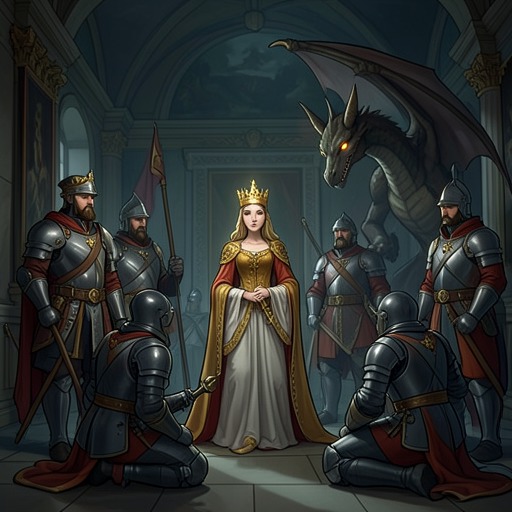
The same expansion becomes formal diplomacy when the King of Gardemagne proposes recognizing Vainqueur as Emperor of Ishfania. With Brandon Maure dead and the region’s army destroyed, Ishfania is left as a resource-rich vacuum that might otherwise provoke another Century War. The treaty would make Vainqueur’s claim official, preserve access to the Adventurer Guild, and allow him to rule as he wished in exchange for mutual protection between Gardemagne and his state. Vainqueur accepts immediately after realizing that recognition also protects his Emperor class. Dragon sovereignty is thus secured through both force and treaty: conquest creates the claim, while human recognition converts it into an international arrangement.
Hoards, Commerce, and War
The dragon hoard gradually becomes an economic institution rather than a private pile of loot. Vainqueur orders Victor to find a way to profit from discarded monster parts, junk, and corpses instead of simply leaving them for animals. This demand links dragon appetite to commercial calculation. Victor is expected to sell waste, prepare Vainqueur’s class progression, and train the Kobold Rangers, making the dragon’s hoard-building dependent on administrative labor and organized production.
The War of the Hoard gives this transformation its military frame. Furibon is defined as an enemy who must be destroyed, and Vainqueur orders research into the dungeon, its traps, defenders, magical barrier, and the means of restoring his hoard to normal. He also seeks strategies for surpassing Furibon as a wizard. The conflict is therefore both personal rivalry and a struggle over ownership, expertise, and the right to control treasure. Vainqueur recruits broadly for the campaign, accepting one hundred Kobold applicants as well as higher-level monsters including a troll, a dryad, and a golem. His declaration that all creatures are equally inferior to him satirizes egalitarian language, yet the recruitment itself broadens the coalition assembled under dragon command.
Afterward, dragon-led commerce becomes explicit in Nethermart, the first fiendish magic-item shop in Outremonde, constructed as a six-floor ivory-draped building in northern Murmurin. Its opening offers goods to monsters and mortals, accepts souls as collateral when customers lack coins, and advertises a thirty-percent weapons sale for the coming war with Maure. The shop places dragon sovereignty within a network of credit, retail, weapons supply, and branded public spectacle. Dragons are no longer only consumers and collectors; their political world can support markets designed for both monster and human customers.
Kinship, Rivalry, and Public Identity
Dragon society includes family continuity as well as competitive display. At Vainqueur’s gathering, six dragons descend to nest on the castle towers, while his close family includes Genialissime, a brown wind dragon, three dragonlings under Vainqueur’s custody after his mating with Blightswamp, and his grown niece Jolie. The dragonlings are black like their mother, and Vainqueur hopes they inherited their father’s intellect. Jolie’s appearance at the gathering and her later first Bragging Day show a culture in which kinship is reinforced through ceremonial visits, gifts, and shared public performance.
The family gathering is also structured by rivalry. Icefang, a white frost dragon nearly as large as Vainqueur, arrives with smug blue eyes and remains Vainqueur’s hated competitor. His inability to breed becomes an object of mockery, while Genialissime acts as both relative and commentator, judging Vainqueur’s speech and joking about the number of princesses he has available. Dragon status is established through size, breeding, treasure, relatives, and the ability to turn personal achievements into stories that an audience must acknowledge.
Bragging Day makes this public identity ceremonial. Vainqueur gathers dragons, minions, and manlings to marvel at the bounties of his domain, his wealth, and his three princesses. He presents himself as an adventurer and rejects the suggestion that he is merely a banker, instead naming himself the Defender of the Hoard. He claims credit for killing Furibon in the First War of the Hoard and the Moth King in the Second, and he presents the Class System as the means by which he protects dragon life from transformation into lead. When the guests begin selecting classes themselves, Vainqueur’s boast becomes a demonstration: his individual advancement supplies a model for dragon collective empowerment.
The celebration ends in contradiction. The princesses are released from magical crystals, but their sight of two hundred dragons terrifies them, and their departure requires Roland to calm them before they are carried away by horses. Vainqueur interprets the failure as a culture clash. His party has successfully displayed dragon magnificence to dragons and allies, yet the same spectacle appears monstrous to the human princesses. The scene preserves the distance between dragon self-image and human perception even as political diplomacy brings the two worlds closer.
Consequences and Narrative Significance
The dragon awakening produces measurable institutional consequences. After Vainqueur is recognized as Emperor by a powerful head of state, gains full dominion over Ishfania’s monsters, and earns new respect as a Monster Lord, he gains a level in Emperor and two levels in Kaiser. He receives Imperial Authority and Malefic Secrecy, the latter causing divination spells and perks aimed at discovering information about him to fail unless they overcome an opposed Charisma check. Dragon power has therefore become not only physical and symbolic but also mechanically protected from external scrutiny.
Yet dragon triumph repeatedly leaves damage in its wake. After Bragging Day, the settlement resembles the aftermath of a volcanic disaster: no house remains untouched and no sheep survives. The Kobold Rangers, gnolls, mimics, and other servants must immediately begin the work of restoring order. This recurring aftermath makes dragon civilization an unstable mixture of magnificence and devastation. The species can build castles, create markets, command armies, secure treaties, and inspire new class identities, but its feasts and ceremonies still reproduce the destruction associated with the ancient monster archetype.
The result is a species defined by transformation without full domestication. Dragons can become nobles, wizards, adventurers, emperors, and even the center of a national language built around Vainqueur’s name; they can gather families, govern monsters, and negotiate mutual protection with Gardemagne. At the same time, their appetite, pride, rivalry, and claim to superiority remain intact. Dragons matter to the narrative because they make civilization itself unstable: under their influence, the frontier is not simply conquered or settled, but dragonized into a political order where hoard, class, commerce, kinship, and catastrophe occupy the same structure.